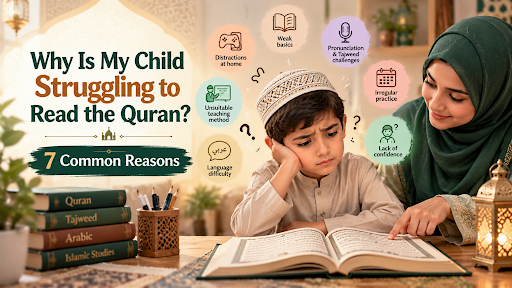
You sit with your child for the purpose of learning Quran, hoping that he will read some verses without difficulty. However, with a few more tries they are still blending Arabic letters, omitting sounds or stopping after each word.
Perhaps you’ve been assisting them at home. Perhaps they’ve been studying Quran lessons for months, but their progress in reading hasn’t been as satisfactory as you thought.
Of course you’re worried as you want your child to have a good relationship with the Quran.
However, remember that if your child is having difficulty reading the Quran it does not mean that they cannot learn.
As children read the Quran, they learn at varying speeds and may have multiple reasons why the process of reading the Quran may feel difficult for them.
The issue might be the pronunciation. Other times it’s an inability to practice, the wrong teaching approach or nerves about getting things wrong.
The first step towards making your child improve is to find out what is getting in his way.
Let’s now examine 7 common problems that children face in reading the Quran and how parents can assist their children.
1. Your Child Hasn’t Mastered the Arabic Alphabet
There is nothing that could be as common as a child skipping over the letters of the Quran to the words and verses.
Children whose first language is English may not have the sounds of Arabic.
For instance, the letters ‘ع’ (ayn), ‘ح’ (ha), and ‘خ’ (kha) can be some of the more difficult letters.
Other letters are the same form but with different sounds. Children can mix up the letters ب (Ba), ت (Ta) and ث (Tha), particularly in their speed of reading.
Without learning letters with confidence, it is very difficult for a child to join letters into words.
What Parents Can Do
Before you begin reading with your child, teach the Arabic alphabet, not the longer verses.
Flashcards, simple pronunciation exercises, and brief daily practice sessions using alphabet flashcards.
One can also request their teacher to evaluate if they require extra time in Noorani Qaida or another beginner level Arabic reading book.
Don’t rush through the basics. Later on reading lessons of the Quran are easier if you have a good understanding of the Arabic letters.
2. They’re Not Practicing Quran Reading Regularly
Can you think of learning to ride a bike and only practicing once every two weeks?
You would most likely lose some of what you learned between sessions.
The same applies to Quran reading.
Children require frequent chances to identify the letters of Arabic script, sound out words and use these in lessons.
Your child may not be able to remember previous lessons if they go to Quran class but do not follow it up with practice at home.
This is particularly prevalent among school-going children in the USA where homework, sport and other activities can take up whole days.
What Parents Can Do
Establish an easy Quran reading schedule according to the schedule of your family.
Your child doesn’t have to study an hour each day.
10–15 minutes of concentrated practice is enough to help them remember what they are learning.
Your child might be able to:
Take 5 minutes to look at Arabic letters.
Learn some words from the word of the day lesson.
Read a brief text with assistance.
To hear the proper recitation of a well-known Surah.
Try to practice at approximately the same time each day.
The ultimate objective is to have your child read the Quran during his/her normal life, not just during class.
3. Your Child Finds Tajweed Rules Confusing
Tajweed is an essential aspect of correctly reading the Quran, however some of its rules may seem confusing to the novice.
Children might have difficulties having an idea of Madd, Ghunnah, Qalqalah etc., or articulating letters from their madem.
At other times they learn a rule from the teacher but forget it when they get to the recitations.
This can cause children to feel “all mixed up,” especially when they’re presented with a lot of rules at once.
It can also be overwhelming for younger learners to master the hard words before they are able to master the basic words.
What Parents Can Do
Gradually introduce Tajweed to your child by the teacher’s consent.
Don’t try and teach your child more than one skill per lesson.
For instance, the teacher could work on long vowel sounds before moving on to more complicated rules for recitation.
It is also beneficial to listen to the recitation of the Quran and recite short passages to help practice pronunciation.
If your child still finds it difficult, a beginner Tajweed online quran academy with teachers who have experience in teaching Tajweed may be able to offer more support with one-on-one lessons.
What’s important is to match instruction to your child’s current ability.
4. The Teaching Method Doesn’t Match Your Child’s Learning Style
All children learn differently.
Some children learn new things quickly when they are told what to do. Others need to see it, hear it a few more times or more practice time.
One teaching strategy that is effective for one child might not be as effective for another.
For instance, the repetitions of pronunciation may be difficult if the teacher rushes through the lessons in a class setting.
Likewise, shorter time periods may be challenging, even for a knowledgeable teacher with younger children.
When your child is constantly confused, distracted or frustrated during quran lessons, the way it is being taught might need to be adjusted.
What Parents Can Do
Talk with your child’s Quran teacher about the problems you are observing.
Discuss how lessons can be more repetitive, reading passages can be shorter and/or include more pronunciation.
Simple activities at home can be done as well, like matching Arabic letters or recognizing sounds, or even revisiting familiar words.
If your child’s progress is slow even though he practices regularly, it is advisable to try another method of teaching.
It is good for a Quran teacher to be flexible on learning in order to meet the age level, understanding, and confidence of the child.
5. Your Child Feels Nervous About Making Mistakes
Sometimes it is not the Arab language that is the main hurdle.
It’s the fear of making a mistake.
When a child is scolded or shaken or is compared to another child, he or she might be reluctant to read aloud.
They may know the letters, but not know the word, or if they do know it, may be frightened to say it wrong.
Children say the words, “I can’t do it” again and again, even after having mastered similar lessons successfully in the past.
This fear may impact their motivation, and cause them to not feel comfortable when reading the Quran.
What Parents Can Do
Provide a positive classroom climate.
Don’t get mad at your child for making a mistake.
Rather, praise their attempt and provide another chance to try.
You could say:
This was a tricky word, let’s hear it again and practice together.
Give praise for small achievements, e.g., identifying a letter or reading a short phrase unaided.
Don’t compare your child’s Quran reading ability to that of siblings, cousins or fellow classmates.
The idea is to enable children to become confident in their own ability to continue to learn, despite their errors.
6. They’re Trying to Learn Too Much Too Quickly
It’s a natural desire of parents that their children make progress.
Some hope that their child will learn to read the Quran fluently in a couple of months. Others may want them to start memorizing longer Surahs as soon as possible.
However, in order to develop the skill of reading the Quran, several skills must be developed simultaneously.
Children need to know Arabic letters, learn to recognise the vowel marks, blend, read and learn to read steadily and fluently.
It’s easy to get overwhelmed trying to learn all these skills at once.
A child can hear a few verses and be able to remember them, but when reading independently cannot read the same verses.
Children are not necessarily behind when they are in these areas. It could just be that they require extra time to build their reading base.
What Parents Can Do
Make goals that are attainable to your child, not a time limit.
Don’t expect them to read an entire chapter in one sitting, but aim for smaller goals.
For example:
Identifying Arabic letter shapes that are alike.
Reading letters that contain Fatha, Kasra and Damma.
Joining letters correctly.
To read a brief passage without a lot of pausing.
Reread and recall past lessons frequently before teaching new concepts.
Keep in mind that it’s better to take a step forward than to move too fast through lessons without understanding.
7. Your Child Isn’t Receiving Enough Individual Attention
There are children who require additional personal supervision.
During a group class, the teacher might not have the time to hear each student recite and to correct each student’s errors.
Also, children who are shy or are having difficulty may not ask questions.
Small pronunciation issues can thus persist without being detected.
This can be especially difficult if you reside with Muslim family in small towns of America where Quran teachers and learning centers may not be readily available.
What Parents Can Do
Discuss with your child’s teacher how they can offer more individualized reading practice.
Request specific comments regarding letters, sounds or reading skills that need improvement.
If there is no personalized instruction available in the area, then consider taking online Quran classes by a private tutor.
A good online Quran academy can provide kids with the ability to connect with teachers who can hear them recite and recognize their errors over and over, and make adjustments to the lessons based on their progress.
When selecting a program, think about the teacher’s credentials, experience with children, format of the day, and how the teacher interacts with parents.
You can also get an idea of how comfortable your child is with the teacher by attending a trial class.
How Can You Tell What’s Causing Your Child’s Quran Reading Difficulties?
Spend some time watching your child read before adjusting his/her lessons.
Are they able to identify letters in Arabic but unable to say the word?
Are they comfortable to read with a teacher, but not comfortable to read in front of family members?
Or do they recall what they have learned in class but not remember it a few days later?
The following observations can help you to determine what support your child needs.
For instance, where children have problems identifying letters this could indicate that some basic work needs to be revised. If a child forgets frequently, it could mean he or she should practice more regularly.
If this is a primary difficulty in pronunciation, support from the teacher might be needed.
Do not have to solve all the problems by yourself. Once a qualified Quran teacher reviews your child’s reading level, he or she can recommend what to do next.
When your child has ongoing issues with reading or language in both English and Arabic, you may wish to speak to their English teacher, or your child’s teacher, or a professional. Not all reading difficulties stem from the lack of practicing the Quran.
How Long Does It Take for a Child to Improve Quran Reading?
Each child has his or her own time scale.
Some children are able to recognize Arabic letters within a short period of time, others require several months of regular practice.
Usually, it takes time and constant guidance to recite full verses of the Quran accurately.
There are a number of factors that influence progress, such as the age of the child, previous experience, practice routine and the teaching method.
Don’t just focus on how many pages your child can read, but rather on the little gains.
Are they able to identify letters more confidently?
Is their pronunciation getting better?
Are they less dependent on help with reading words they know?
Are they getting more comfortable reading?
These are all positive steps forward.
How to Make Quran Reading Easier for Your Child at Home
Reading and studying the Quran can be done by parents even if they are not fluent in the Arabic language.
There are a few simple things that could make your everyday practice a little bit easier.
Make workouts brief. Short sessions may be more effective for younger children than longer ones.
Select a quiet place for the learning. Turn off the television, mobile games etc. that distract.
Employ listening and repetition. Help your child listen for clear recitation and to practice familiar words at a comfortable speed.
Review older lessons. Remind children of what they have learned before, which will strengthen their reading ability.
Remain engaged with teacher. Discuss what skills your child needs to work on in between lessons.
Make progress visible. Children can easily see the progress made without the pressure of a complicated weekly chart.
If your child requires consistent teacher feedback, but you don’t have appropriate local lessons, then you can also look into structured lessons via an online quran academy.
The most crucial point is to make it feel supportive and manageable to learn Quran.
Frequently Asked Questions
Is it okay if children have problems reading the Quran?
Yes. Arabic letters, sounds and rules of Tajweed are difficult for many beginners. It takes some children more time and practice to become confident in reading the Quran.
Why doesn’t my child remember the Arabic letters?
Letters may be forgotten if they are not used regularly and children have not mastered the difference between similar looking letters. Short revision sessions, flash-cards, repetition can be useful for establishing recognition.
Should I stop my child from Quran lessons if he is a problem?
Not necessarily. First, it is important to try and find out what may be causing the problem. May need to modify the speed of the lesson, practice with basic concepts, or try a different method of instruction. If your child is under a lot of stress, try having a short break or lighter schedule, with conversations with teacher about their needs.
Is my child able to learn to read Quran without being able to speak Arabic?
Yes. Children can learn Arabic letters, pronunciation and learn to read the Quran without speaking conversational Arabic. Also, the meaning of each verse in the Quran can be introduced slowly as they become proficient.
Do online Quran classes help kids that are not good readers?
They can be useful when the lessons are conducted on a one-to-one basis and allow for frequent pronunciation feedback and a child’s age-appropriate speed. The quality of teaching and the child’s familiarity of online learning will be relevant, however.
What amount of Quran reading practice should be given to my child on a daily basis?
10-15 minutes of focused practice per day is a good starting point for many beginners. Shorter sessions may be required for younger learners, and longer practice periods for older or more experienced learners.
Final Thoughts
If your child has been making great efforts to read the Quran for months, while you still see him/her struggling, it can be frustrating.
Learning to read Arabic letters, say the sounds and recite the words with Tajweed and fluency doesn’t mean your child can’t be successful.
Children have to practice more. They may require a different teaching method, more special attention or greater encouragement.
As a parent, you don’t have to teach your child all of the things that they need to know really fast. It is to support them in the process of the development of their ability to read the Quran.
First, find out what the problem is, talk with their teacher, and make minor adjustments to their learning schedule.
Most of all, praise them on the journey!
Your child is not supposed to learn the Quran in a few weeks as a perfect reciter. They should be patient, well led and then have the courage to try again.