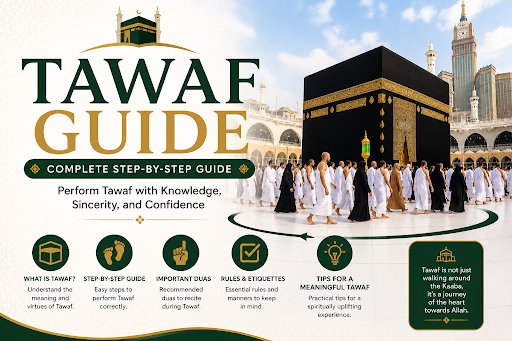
Tawaf is one of the most important acts of worship performed during Umrah. It involves walking around the Holy Kaaba seven times in a spirit of devotion, humility, and remembrance of Allah. For many pilgrims, Tawaf is an emotional and deeply meaningful experience because it takes place in the sacred Masjid al-Haram in Makkah. Understanding the correct method beforehand can help you perform it calmly and confidently.
This Tawaf guide explains the essential steps, preparations, etiquette, and common mistakes to avoid while performing Tawaf during Umrah.
What Is Tawaf?
Tawaf means circumambulating the Kaaba. During Umrah, pilgrims perform seven complete circuits around the Kaaba, keeping the Kaaba on their left side throughout the Tawaf.
Each complete round begins near the Black Stone, known as Hajar al-Aswad, and ends when you return to the same point. Tawaf is an act of worship, so pilgrims should focus on remembering Allah, making dua, and maintaining good manners throughout the process.
Prepare Yourself Before Tawaf
Before beginning Tawaf, make sure you are prepared physically and spiritually. You should have performed Wudu and be in a state of ritual purity. Your clothing should be clean and appropriate for Ihram.
Men wear Ihram clothing, while women wear modest Islamic clothing suitable for worship. Make sure your footwear and belongings are secure because the area around the Kaaba can become extremely crowded.
It is also helpful to use the restroom and drink enough water before starting, particularly during hot weather. However, avoid drinking excessively immediately before Tawaf.
Make Your Intention
Before starting Tawaf, make the intention in your heart that you are performing Tawaf for Umrah for the sake of Allah.
There is no requirement to recite a particular sentence loudly for the intention. Your sincere intention in your heart is what matters.
Once you are ready, position yourself so that you can begin from the area aligned with the Black Stone.
Start Tawaf From the Black Stone
Tawaf begins at Hajar al-Aswad. If possible without harming or pushing anyone, you may touch or kiss the Black Stone.
Because the area can be extremely crowded, never push, shove, or hurt another pilgrim to reach it. If reaching the Black Stone is difficult, you can face it and gesture toward it with your right hand while saying “Bismillah, Allahu Akbar.”
Then begin walking around the Kaaba in a counterclockwise direction.
Complete Seven Circuits
You must complete seven circuits around the Kaaba. Keep the Kaaba on your left throughout every round.
Walk at a comfortable pace and avoid rushing unnecessarily. The crowds may move slowly, particularly during busy seasons. Stay patient and concentrate on your worship.
Men may perform Ramal, which means walking briskly with shorter steps, during the first three circuits when circumstances allow. The remaining four circuits are normally completed at an ordinary walking pace.
If the crowd is too dense or brisk walking could inconvenience others, maintaining safety and avoiding harm should take priority.
What Should You Recite During Tawaf?
There is no specific dua that must be recited during every circuit of Tawaf. You can make personal dua, recite Quran, Read Surah yaseen, perform dhikr, or praise Allah according to your ability.
Many pilgrims choose to remember Allah throughout the Tawaf and ask for forgiveness, guidance, mercy, and blessings.
Between the Black Stone and the Yemeni Corner, it is traditionally recommended to recite:
“Rabbana atina fid-dunya hasanatan wa fil-akhirati hasanatan wa qina adhaban-nar.”
This means: “Our Lord, give us good in this world and good in the Hereafter, and protect us from the punishment of the Fire.”
You do not need to follow complicated dua lists. Sincere worship and remembrance are more important than memorizing numerous supplications.
The Yemeni Corner
The Yemeni Corner is another corner of the Kaaba. When possible, pilgrims may touch it without pushing or causing difficulty for others.
Unlike the Black Stone, you should not gesture toward the Yemeni Corner from a distance if you cannot reach it. Continue your Tawaf peacefully and avoid creating congestion.
The goal is worship, not simply reaching particular points around the Kaaba.
Completing Your Seventh Round
Continue walking around the Kaaba until you have completed seven full circuits. Keep track carefully so you do not accidentally add or miss a round.
If you become uncertain about your count, follow the stronger assumption based on what you are reasonably sure you completed. If you have questions about a specific situation, consult a qualified scholar or knowledgeable religious guide.
After completing the seventh circuit, move away from the immediate Tawaf area when possible so other pilgrims can continue comfortably.
Pray Two Rakahs After Tawaf
After completing Tawaf, pilgrims traditionally perform two Rakahs of prayer. If it is possible without causing inconvenience, these may be performed near Maqam Ibrahim. However, you do not need to force your way into a particular location.
If the area around Maqam Ibrahim is crowded, you can pray elsewhere within Masjid al-Haram.
After the prayer, you may make dua and ask Allah to accept your worship.
Zamzam and Moving to Sa’i
After Tawaf and the two Rakahs, pilgrims may drink Zamzam water and make dua.
The next major part of Umrah is Sa’i, which involves walking between Safa and Marwah seven times. Before beginning Sa’i, make sure you understand where to proceed and follow the directions provided inside the Haram.
Pilgrims should remain patient because the route can become busy, especially during peak periods.
Common Mistakes to Avoid During Tawaf
One common mistake is pushing people to reach the Black Stone. This should be avoided because causing harm or serious inconvenience to another Muslim goes against the spirit of worship.
Another mistake is believing that every circuit requires a specific dua. There is no need to memorize seven different supplications.
Some pilgrims also become distracted by taking photographs or using their phones excessively. While documenting a journey may be meaningful, Tawaf is primarily an act of worship, so keeping your attention on Allah is preferable.
Avoid walking against the flow of pilgrims, stopping suddenly in crowded areas, or blocking pathways.
Tawaf Tips for a Peaceful Experience
Try to learn the basic steps before arriving in Makkah. If you are traveling through one of the many available Umrah packages 2027, ask your travel group whether they provide religious guidance before or during the pilgrimage.
Wear comfortable footwear suitable for the surrounding areas, keep your belongings secure, and stay hydrated. Follow official instructions and security guidance inside Masjid al-Haram.
Most importantly, remain patient. Tawaf can be physically demanding, especially when the Haram is crowded. Focus on worship rather than worrying about completing every action perfectly.
Final Thoughts
Tawaf is a remarkable part of Umrah that brings pilgrims together around the Kaaba in worship and remembrance of Allah. By understanding how to begin Tawaf, complete seven circuits, make dua, observe proper etiquette, and avoid harming others, you can approach this sacred act with greater confidence.
Prepare beforehand, keep your intention sincere, remain patient with fellow pilgrims, and remember that Tawaf is not simply a physical walk around the Kaaba. It is an opportunity to turn your heart toward Allah, seek forgiveness, express gratitude, and pray for yourself and those you love.
May Allah accept the Umrah of every pilgrim, make their journey easy, and grant them a sincere and accepted Tawaf. Ameen.